Strategic Premise
The funnel was designed as a controlled progression aligned with narrative pacing, ensuring that operational automation supported the experiential journey rather than interrupting it.
User progression followed a defined lifecycle sequence:
Landing → Delivery → Tagging → Email → Offer → Payment → Confirmation
Each transition preserved message continuity and contextual relevance across stages.
Automation therefore functioned as behavioral infrastructure, reinforcing the narrative system established in the messaging architecture.
Backend Architecture
Automation infrastructure supported several lifecycle components.
Entry Context Recognition
User entry pathways triggered conditional tagging to identify:
Origin context
Content pathway
Behavioral intent signals
This ensured downstream communication aligned with the user’s initial engagement context.
Segmented Lifecycle Sequencing
Email delivery sequences were structured to reflect:
Contextual entry tags
Engagement pacing
Progressive narrative reinforcement
Follow-up communication therefore remained aligned with the original message architecture.
Trigger Timing Discipline
Automation triggers were configured to preserve pacing across the user experience.
Timing logic prevented:
Message overload
Sequence compression
Contextual misalignment between content stages
This maintained narrative rhythm throughout the lifecycle sequence.
Confirmation and Transaction Flow
The transaction layer integrated with:
Payment gateway processing
Confirmation sequence delivery
Fulfillment validation
Payment completion triggered confirmation logic designed to maintain continuity between transactional action and post-action messaging.
System Integrity Testing
Each automation stage was evaluated for operational stability.
Testing focused on identifying potential failure points including:
Sequence leakage between stages
Tagging inconsistencies
Trigger timing conflicts
Confirmation flow disruption
This ensured automation integrity across the full lifecycle path.
Validation Signals
Observed behavioral indicators reflected system alignment:
Sustained interaction with long-form content
Returning user behavior across sessions
Extended engagement duration within narrative sections
These indicators suggested that automation logic reinforced the experiential structure rather than fragmenting it.
Automation Integrity Model
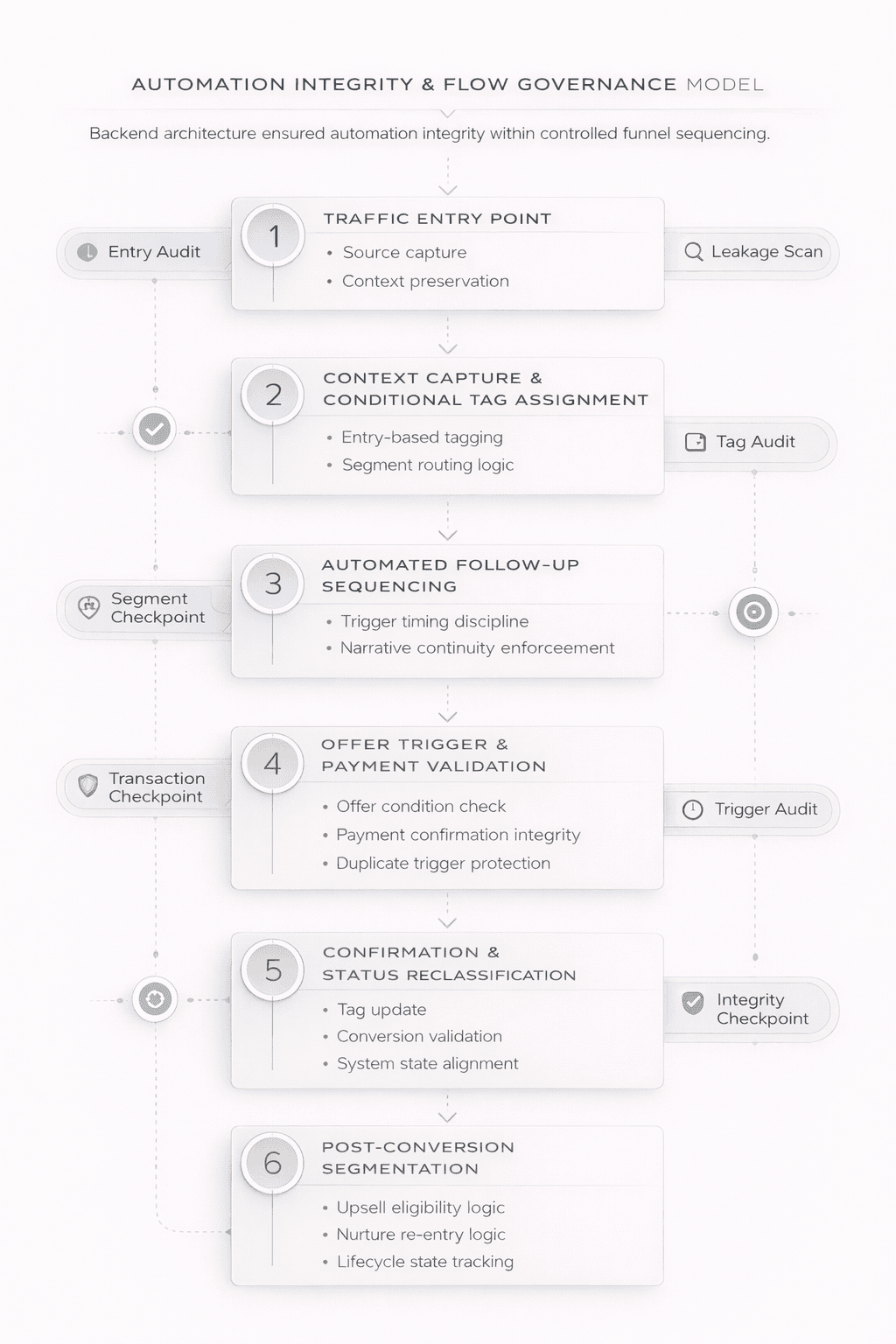
The diagram illustrates how conditional tagging, sequencing discipline, and trigger governance preserved continuity across the lifecycle path from entry through confirmation.
Return to Operational Alignment →