Strategic Premise
Before layout, tooling, or automation decisions were introduced, audience intent and narrative progression were defined.
The messaging architecture governed both:
External clarity
Positioning, hierarchy, and contextual call-to-action placement.
Internal progression
Emotional pacing and identity alignment guiding the experiential journey.
Narrative structure and system infrastructure were developed in parallel, preserving coherence between message, interface behavior, and system delivery.
Structural Model
The messaging framework operated across four components:
1️⃣ Core Positioning
Mission clarity and thematic differentiation establishing the system’s central identity.
2️⃣ Audience Intent Mapping
Psychological motivations and contextual expectations identified prior to design execution.
3️⃣ Narrative Hierarchy
Message progression structured from
awareness → clarity → depth → invitation.
4️⃣ Experiential Escalation
Strategic placement of immersive narrative assets designed to deepen engagement without disrupting structural flow.
Together, these elements formed the narrative foundation guiding interface design, user progression, and conversion sequencing.
Validation Signals
Behavioral indicators later reflected structural alignment:
Increased engagement duration
Returning user behavior
Sustained interaction within long-form narrative sections
Messaging was structured to guide both cognition and immersion, ensuring that narrative structure supported experiential continuity.
Narrative Escalation Model
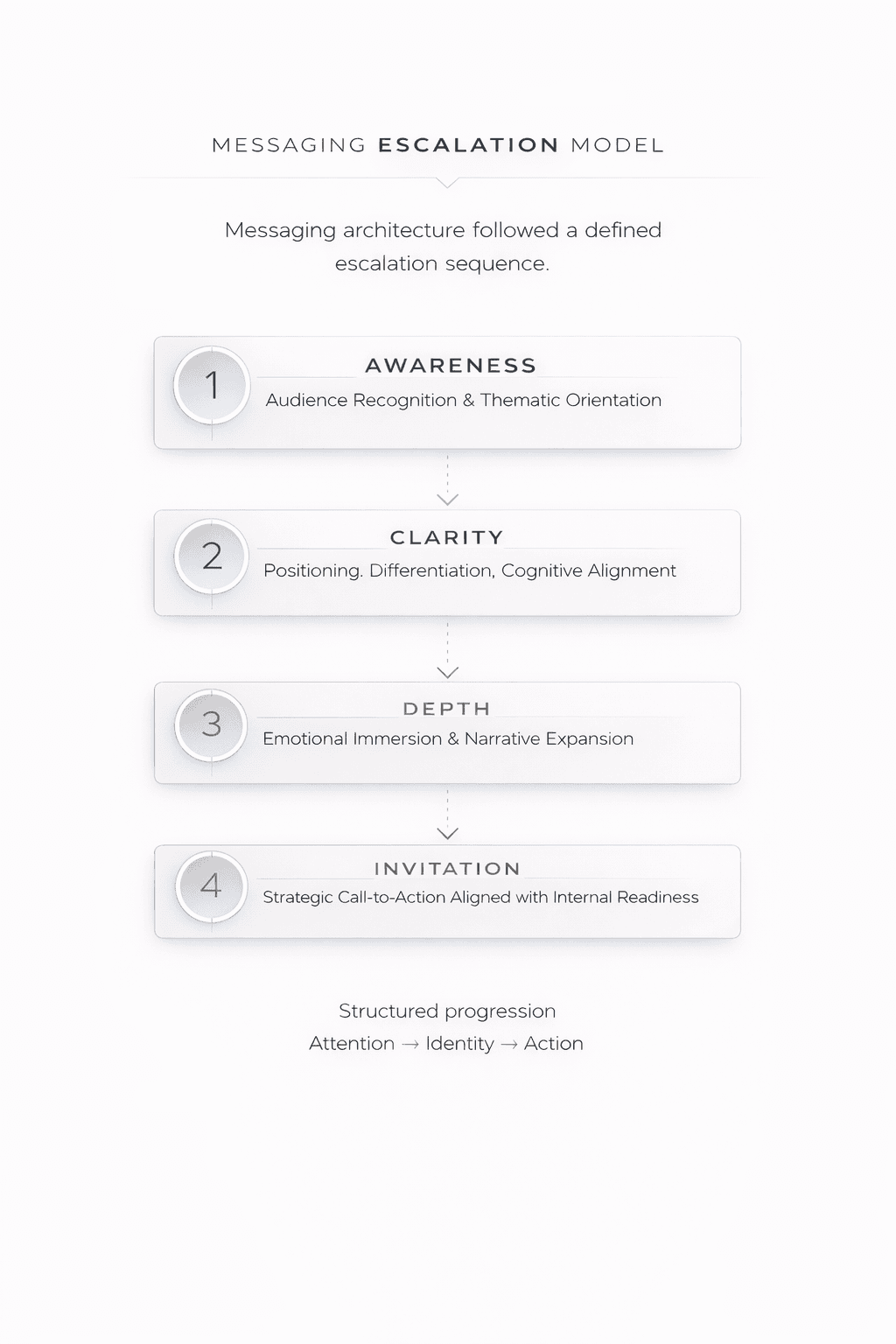
The diagram illustrates how narrative progression was structured to move users from orientation to deeper identity alignment before presenting invitation-based calls to action.
Return to Discoverability →